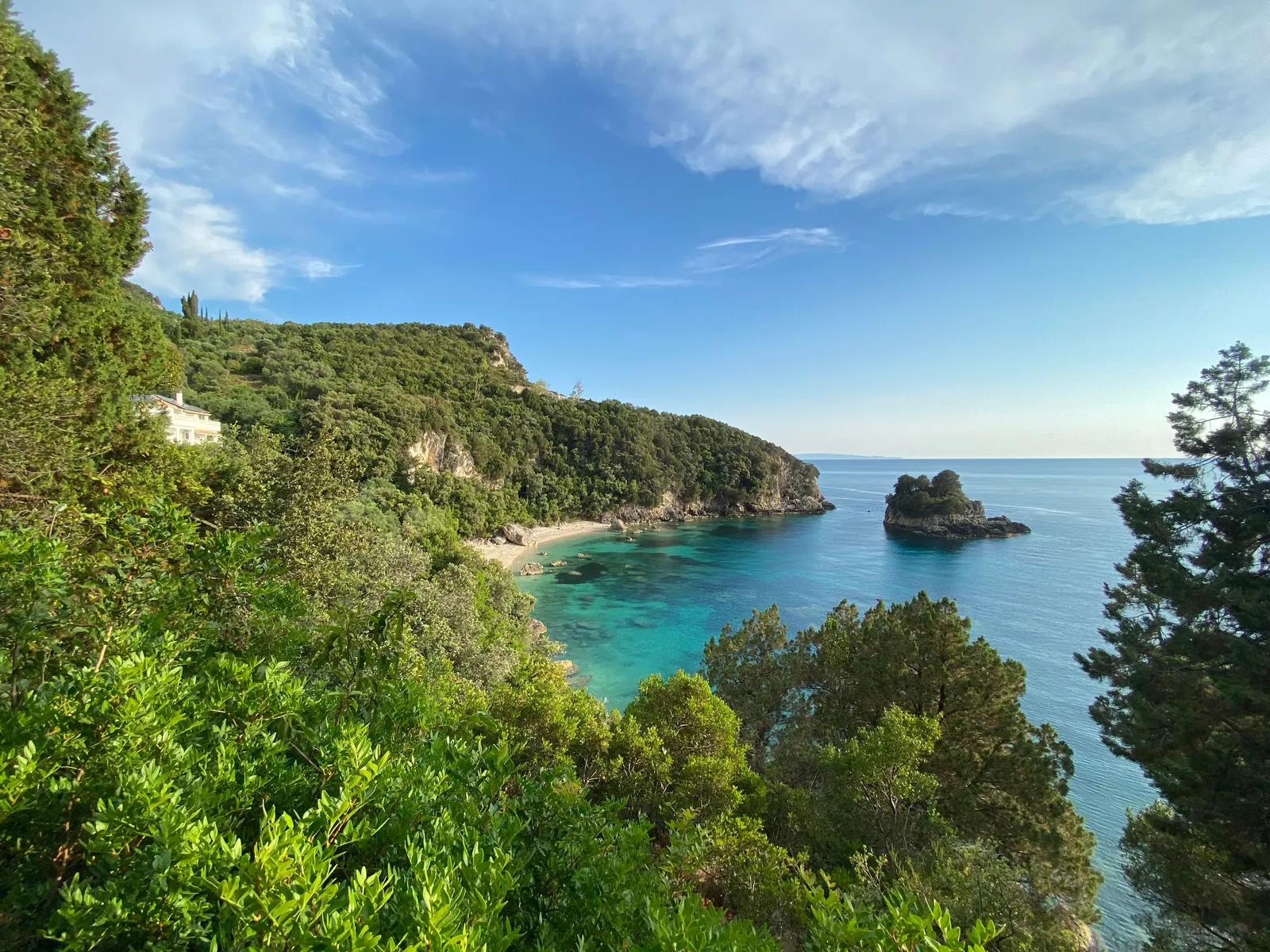
Corfu does not look or taste like the Aegean. It rains here, which is why it is green: cypress, olive groves that were planted under Venetian rule and never cleared, and hills that stay dark all summer. It was never under Ottoman rule, so the architecture is Venetian, French and British instead, and the food carries Italian influence you will not find in the Cyclades.
Five days and a car covers the island properly, with a boat trip to spare. Read the Corfu guide for background, and where to stay in Greece if you are still working out the shape of the trip.
Itinerary at a glance
| Day | Area | Signature experience |
|---|---|---|
| 1 | Corfu Town | Two fortresses, an arcade and a cricket ground |
| 2 | Paleokastritsa | Six bays, a headland monastery and a castle above |
| 3 | The northeast and Pantokrator | An abandoned village on the mountain |
| 4 | The west coast | The walk down to a double bay |
| 5 | Paxos and Antipaxos | Sea caves and impossibly clear water |
Day 1: Corfu Town
The old town is a UNESCO site and it reads as a layered history lesson. Venetian rule for four centuries left the tall narrow houses and the lanes between them. The French left the Liston, an arcaded terrace of cafes modelled on the Rue de Rivoli in Paris. The British, who administered the island in the nineteenth century, left a palace, a bandstand and a cricket ground, on which cricket is still played, in the middle of the town’s main green.
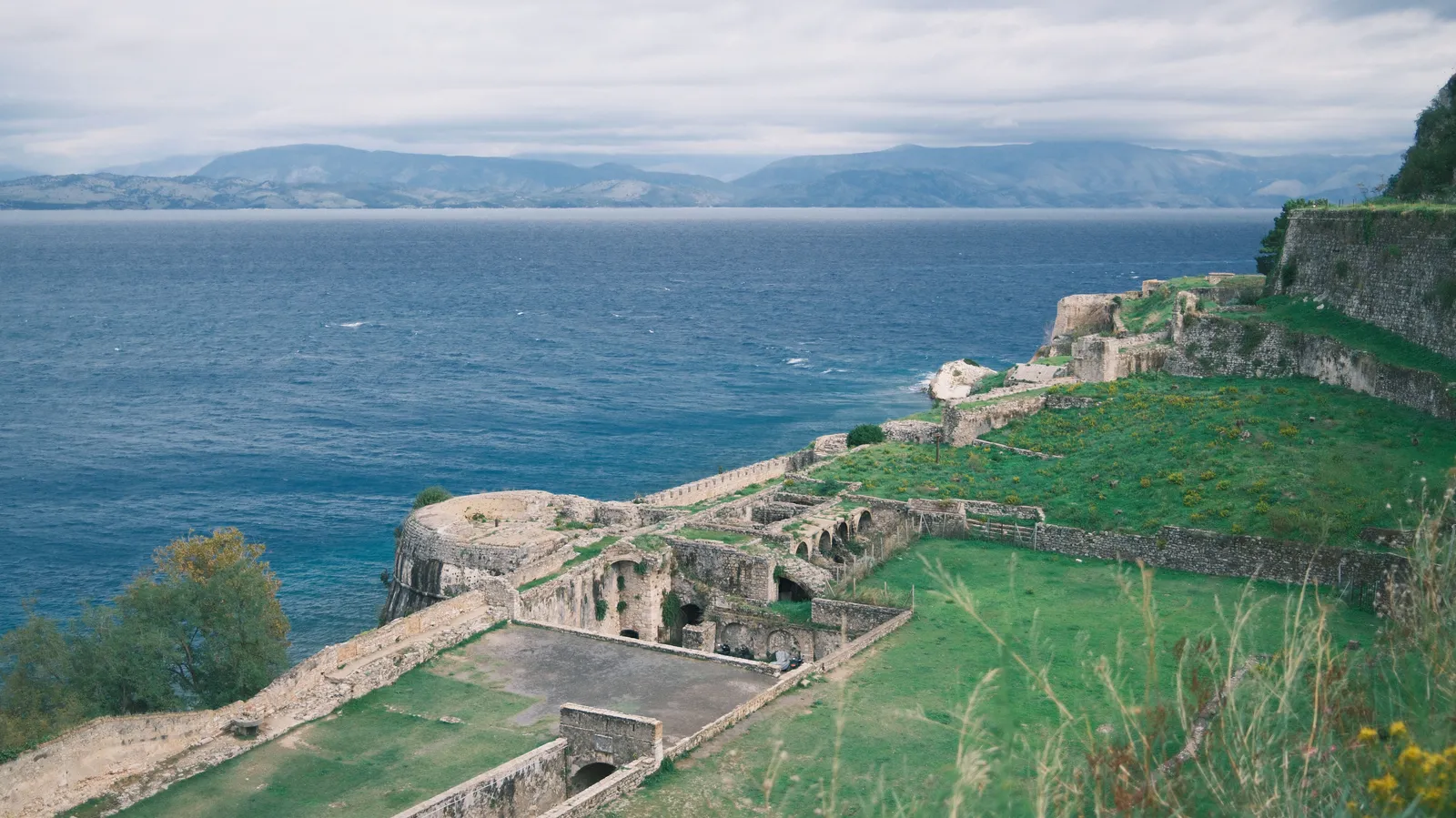
Two fortresses bracket the old town: the Old Fortress on its rocky islet to the east, the New Fortress above to the northwest. Wow moment of the day: the climb up the New Fortress for the roofscape, a compressed mass of terracotta and washing lines with the sea on both sides.
Eat the island’s own dishes, which exist nowhere else in Greece: pastitsada, a spiced beef and pasta dish, and sofrito, veal in a garlic and parsley sauce, both Venetian in origin. Finish with kumquat liqueur, made from a fruit the British introduced here.
Day 2: Paleokastritsa
The northwest coast folds into a series of small bays with wooded slopes coming right down to the water. Paleokastritsa is the best known, six coves with a monastery on the headland between them, founded in the thirteenth century and still working.
Small boats run from the beaches to caves and coves that the road cannot reach, and this is the way to see the coast properly. It is a short trip and it is inexpensive by island standards.
Above, Angelokastro is a ruined Byzantine castle on a pinnacle with a view along the whole west coast. It was never taken by siege, which the site makes entirely believable. The walk up from the parking is short but steep.
Lunch on the water at one of the bay tavernas, where the fish is priced by weight. Honest note: ask for the price per kilo before it is cooked, which is normal practice and avoids the standard misunderstanding.
Day 3: The mountain and the ghost village
Mount Pantokrator is the island’s high point, and the road up gives you views across to the Albanian coast, which is startlingly close.
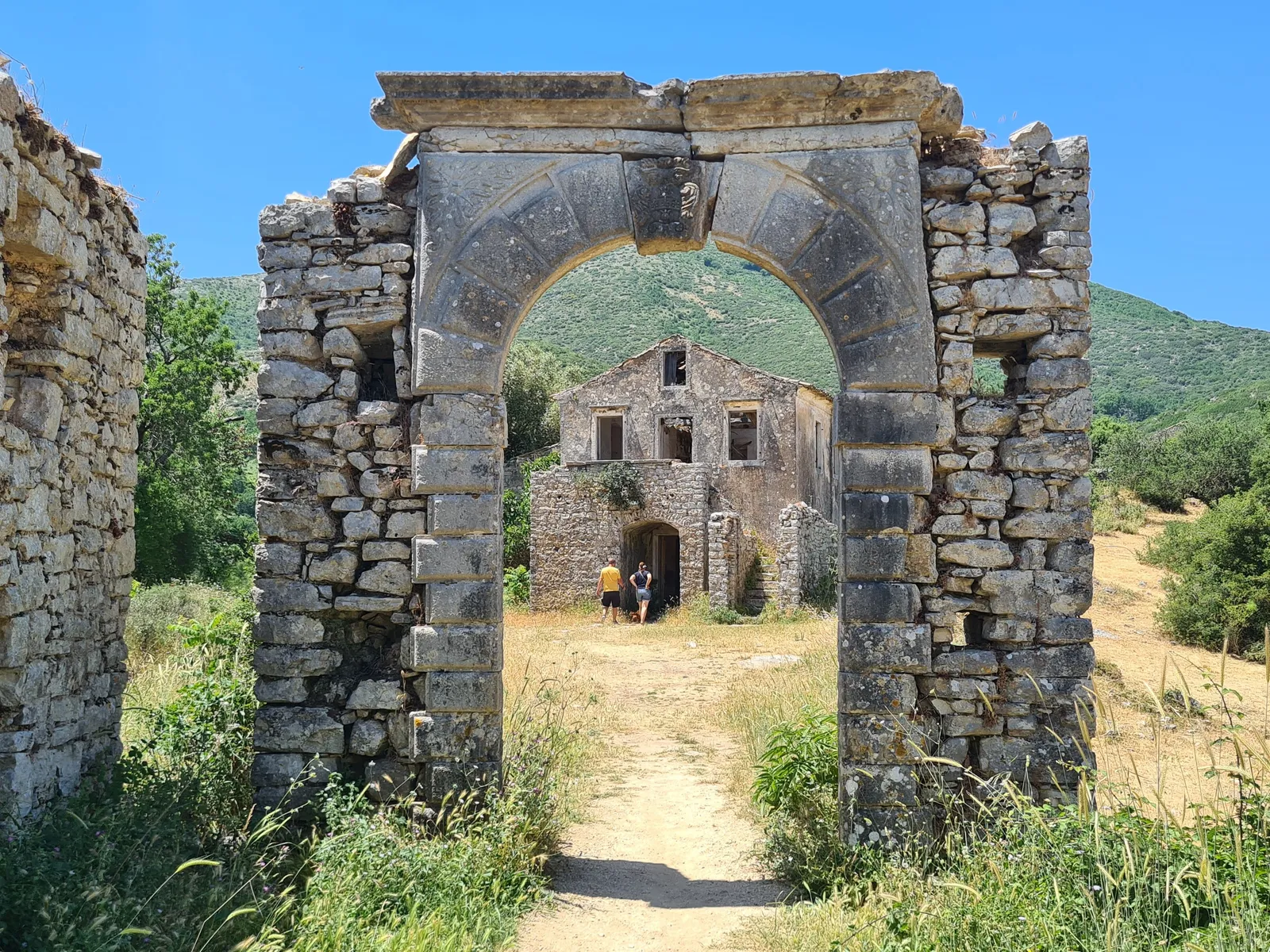
Wow moment of the day: Old Perithia, on the northern slopes. A fourteenth century village of stone houses, founded high up because the coastal plains were malarial. When malaria was eliminated in the twentieth century the reason to live at altitude disappeared, and everyone moved down to the sea, leaving around a hundred and thirty houses and eight churches standing empty.
It is not entirely empty now. A handful of tavernas operate in the square, some houses are being restored, and the village has protected status. Walking through it you pass roofless shells and restored facades in the same lane, which is exactly what a place halfway back to life looks like. Have lunch there; the tavernas are the reason the village survives.
Below on the coast, Kassiopi is a pleasant harbour village with a ruined castle, and the northeast bays around it are the quiet, expensive end of the island.
Day 4: The west coast and Porto Timoni
The west is where the beaches are. Glyfada and Agios Gordios are the big sandy ones, backed by cliffs.
The one worth the effort is Porto Timoni, a double bay where a narrow neck of land has sea on both sides. It is reached on foot from Afionas village, down a steep rough path.
Honest safety note: the descent is a proper scramble in places, there is no shade at all on it, and there is nothing at the bottom, so take water and wear real shoes rather than sandals. Going down in the middle of a hot afternoon is the mistake people make.
On the way, stop at the Lakones viewpoint above Paleokastritsa, which is the classic photograph of the island’s west coast, and at the villages inland where the olive terraces still have their stone walls.
Day 5: Paxos and Antipaxos
Boats run south to Paxos, a small green island of olive groves and three harbours, and to Antipaxos, whose beaches have water so clear and pale that photographs of it are routinely accused of being edited.
The standard day trip takes in the sea caves and blue arches along the west coast of Paxos, a stop at Gaios or Lakka for lunch, and swimming off Antipaxos. It is the best day out from Corfu and it is worth the early start.
Honest note: it is a long day on a boat and it is weather dependent, so do not put it on the day before a flight. If the sea is up, the alternative is to drive south to the lagoon at Korission and the long empty beaches on the island’s southwest.
Where to base yourself
Corfu Town is the practical choice for five days, central for everything and the only base where the evenings have life beyond your hotel. Paleokastritsa and the northwest put you next to the best of the coast, at the cost of a drive into town. The northeast, around Kassiopi and Agios Stefanos, is the quiet and expensive corner where the villa rentals are. The south, around Kavos, is the young package end and worth knowing about so that you choose it deliberately or not at all. Wherever you land, the island is small enough that nothing is more than about an hour away.
Practical tips
- You need a car for days three and four. Buses serve the main resorts and not much else. See car rental in Greece.
- When to go: May, June and September. Corfu gets real rain in spring and autumn, which is what keeps it green, and July and August are the package peak. See the best time to visit Greece.
- Getting here: Corfu has an airport and a ferry link from the mainland at Igoumenitsa. It is not practically connected to the Cyclades, so treat it as a separate trip. See island hopping by ferry.
- Roads: the interior and the northeast have narrow, steep, unmarked lanes. Take the smallest car you are comfortable with.
- Food: the Venetian influenced dishes here are genuinely different. See the Greek food guide.
- Beaches: for how Corfu compares nationally, see the best beaches in Greece.