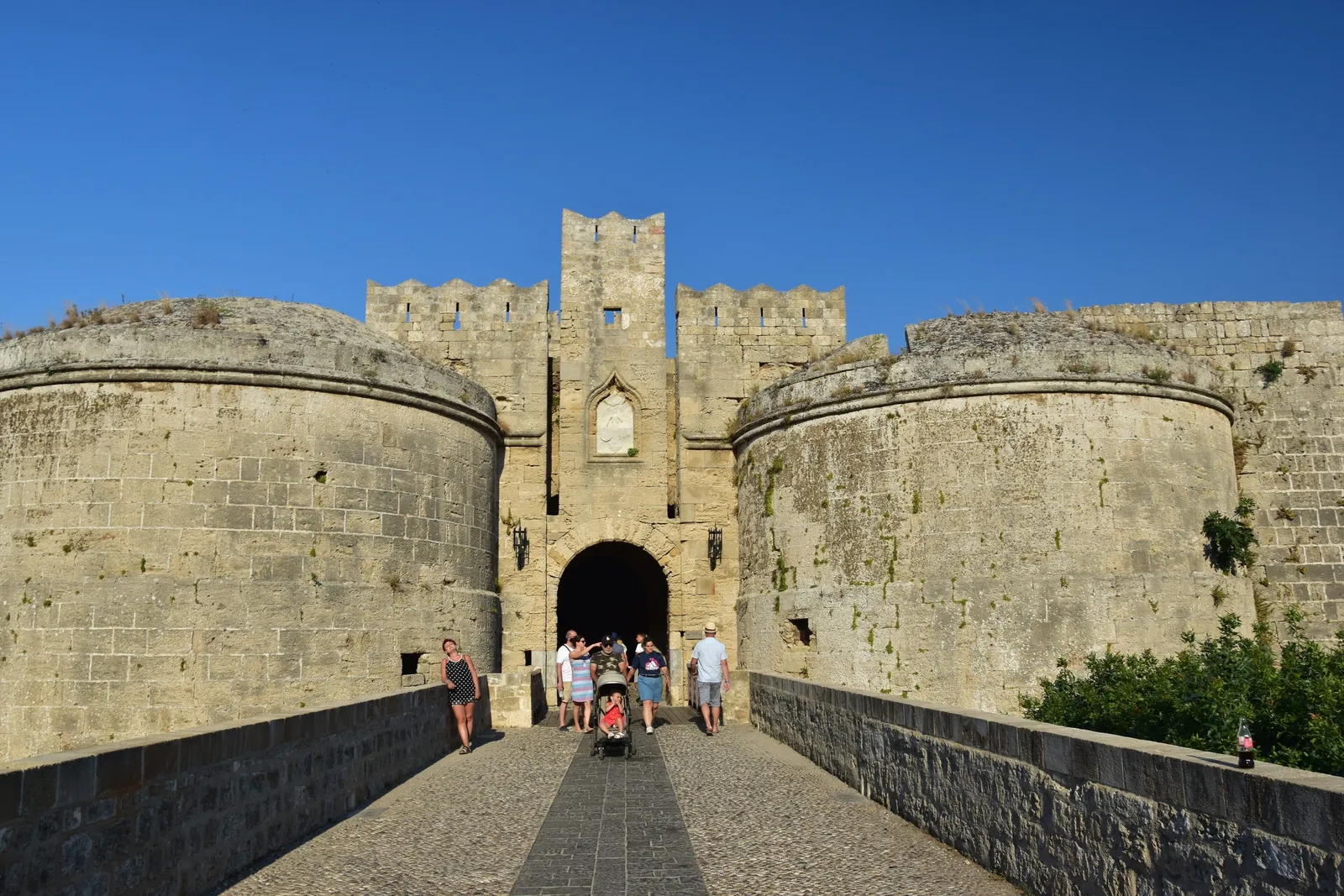
Rhodes is two islands in one. There is the package coast in the north, and there is a walled medieval city that the Knights of St John spent two centuries building, a Hellenistic acropolis above a white village, and a mountainous interior of wine villages and ruined castles that almost nobody drives into.
Five days lets you do all of it and still take the boat to Symi, which is arguably the prettiest harbour in Greece. Read the Rhodes guide first, and plan the hop with the ferry guide.
Itinerary at a glance
| Day | Area | Signature experience |
|---|---|---|
| 1 | Rhodes old town | The Street of the Knights, and the empty moat |
| 2 | Lindos | The acropolis above the white village |
| 3 | Symi | A harbour where every house matches |
| 4 | The interior | Wine villages, Kamiros and a castle on a rock |
| 5 | The north | The butterfly valley and a restored spa |
Day 1: The old town
Rhodes old town is the largest inhabited medieval town in Europe, still walled, still lived in, and still full of ordinary life behind the tourist lanes.
The Street of the Knights runs uphill in a straight line from the hospital, now the archaeological museum, to the Palace of the Grand Master at the top. Each building along it belonged to a different national grouping of the order, and their coats of arms are still above the doors. It is one of the most complete medieval streets anywhere.
Wow moment of the day: the moat. It never held water, it is now a long grassy park running right around the outside of the walls, and it is almost empty even in August while the lanes inside are shoulder to shoulder. You can walk most of the circuit in an hour.
Eat in a courtyard away from the main drag. Honest note: the restaurants immediately on Sokratous and around Hippocrates Square are the ones with people outside inviting you in, and they are not where locals go.
Day 2: Lindos
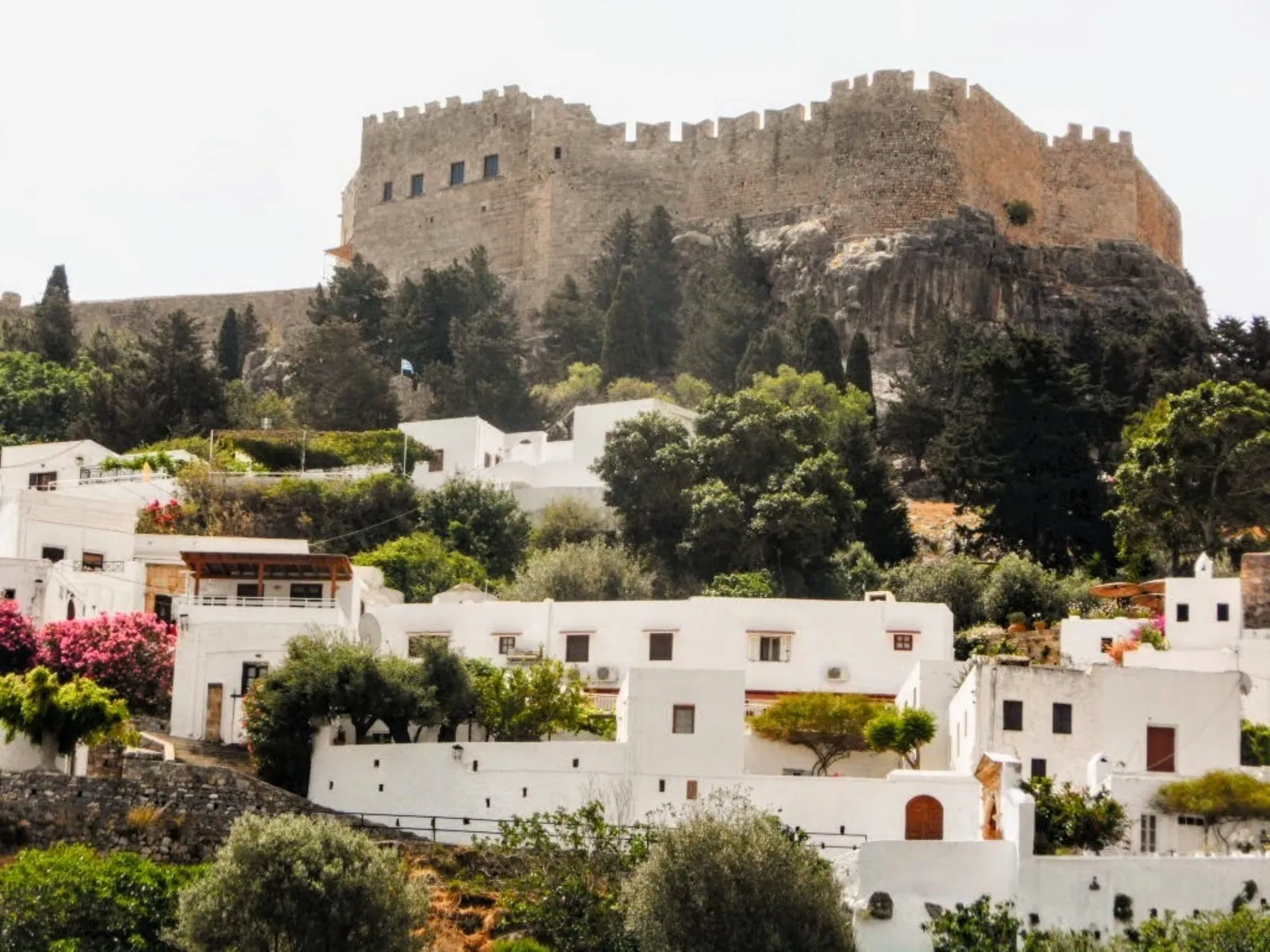
Fifty kilometres down the east coast, Lindos is a village of flat roofed white houses in a bowl, with a Hellenistic acropolis on the rock above and two bays below.
The climb up is the day. At the top there is a temple of Athena, a great stoa of columns, and crusader walls wrapped around the outside of it all, because the Knights fortified the ancient site rather than clearing it.
Honest note: the path up is steep, stepped and completely unshaded, and it gets very hot. Go early. Donkeys are offered for the climb and, as elsewhere in Greece, their working conditions are a real welfare concern, so walking is the better choice.
Below, St Paul’s Bay is a near enclosed circle of water with a narrow opening to the sea, and it is the swim of the day.
In the village itself, look for the captains’ houses, seventeenth and eighteenth century mansions with carved doorframes and pebble mosaic courtyards. Several are open.
Day 3: Symi
The boat north takes you to an island of around three thousand people and one of the great harbour views in the Mediterranean.
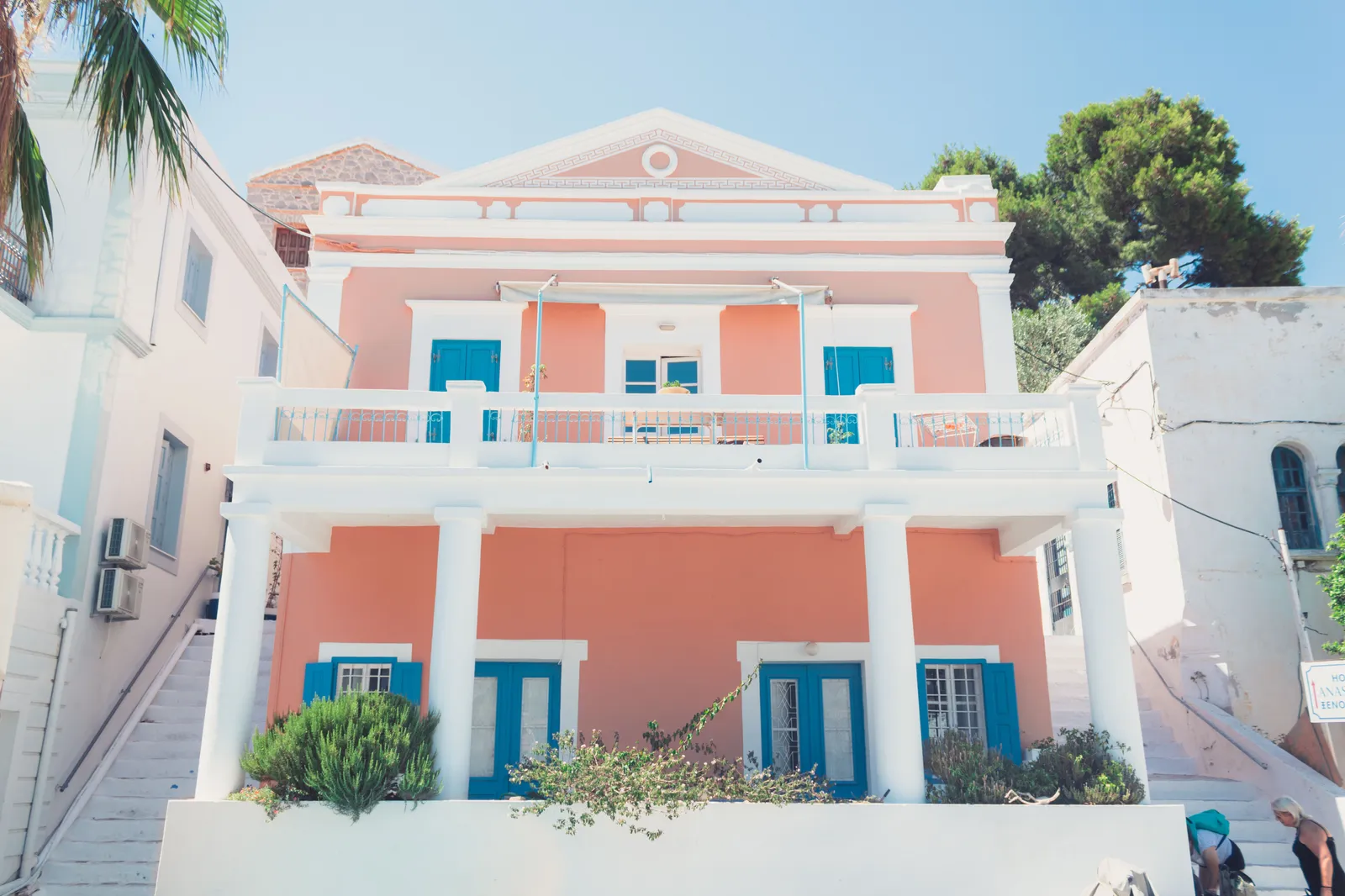
Symi grew rich on sponge diving and shipbuilding in the nineteenth century, and the merchants built neoclassical mansions in ochre, cream and terracotta stacked up both sides of the port. A strict building code has kept it that way ever since, so the entire amphitheatre of the harbour reads as one deliberate composition rather than a hundred separate decisions.
Wow moment of the day: the approach. The harbour opens up all at once as the boat rounds the headland, and it is genuinely startling.
Climb the Kali Strata, the broad stone staircase of several hundred steps from the port up to the old village of Chorio, ideally in the late afternoon. Most day trippers never leave the waterfront.
Boats usually also call at Panormitis, the large monastery in a bay on the south of the island.
Eat the Symi shrimp, a tiny local prawn that is fried and eaten whole, shells and all.
Honest note: this is a full day boat trip and it is weather dependent, so do not schedule it for the day before you fly.
Day 4: Into the interior
Rhodes inland is mountainous, wooded and empty, and the drive is the point.
Kamiros on the west coast is one of the island’s three ancient cities, an entire Hellenistic town plan of streets, houses and water cisterns on a hillside above the sea, with no medieval layer on top of it. It is far quieter than the old town and, for understanding how people actually lived, considerably more informative.
Embona, under Mount Attavyros, is the island’s wine village, growing athiri and mandilaria on the mountain slopes, with several wineries open for tasting.
Monolithos in the southwest is a small castle perched on an isolated rock with a sheer drop on every side and a tiny chapel inside. There is no railing to speak of and the view is enormous.
Day 5: The north
Petaloudes, the Valley of the Butterflies, is a wooded gorge with wooden walkways and streams where Jersey tiger moths gather in enormous numbers in the summer months. Two honest notes: they are moths rather than butterflies, and the phenomenon is strictly seasonal, roughly June to September, so outside that window you are visiting a pleasant shady valley and nothing more. Visitors are asked not to clap or make noise to make them fly, because disturbing them costs the moths energy they cannot spare.
Kallithea Springs is the other stop: an Italian era spa complex from the nineteen twenties, built in an extraordinary mix of art deco and orientalist styles around domed rotundas on the sea, now restored, with swimming off the rocks below.
Finish at Faliraki or on the quieter bays north of it, or head back into the old town for a last evening inside the walls.
Practical tips
- You need a car for days four and five. The east coast has buses, the interior does not. See car rental in Greece.
- When to go: May, June, September and October. Rhodes has a long season and the interior is very hot in high summer. See the best time to visit Greece.
- Getting here: Rhodes has good flight connections and ferry links through the Dodecanese, but it is a long way from the Cyclades. Treat it as its own trip. See island hopping by ferry.
- Old town driving: the walled town is largely closed to cars and parking outside it is limited. Base yourself with that in mind.
- Beaches: the east coast is sandy and sheltered, the west is windy and better for surfing. See the best beaches in Greece.
- Food: see the Greek food guide for what to look for on a Dodecanese menu.