Almost everyone who lands in Athens flies straight out to an island. The peninsula that starts an hour west of the city has the best preserved ancient theatre in the world, the citadel that launched the Trojan war story, an abandoned Byzantine city on a mountainside, and a fortified town that is invisible from the mainland because it hides behind its own rock.
Five days with a car does it properly. This pairs naturally with five days in Athens for a mainland trip with no ferries at all. Read first time in Greece for the basics, and sort the car before you go: see car rental in Greece.
Itinerary at a glance
| Day | Base | Signature experience |
|---|---|---|
| 1 | Corinth to Nafplio | The canal, then Greece’s loveliest small town |
| 2 | Argolid | Epidaurus at dawn, Mycenae after |
| 3 | Sparta and Mystras | A Byzantine city abandoned on a hillside |
| 4 | Monemvasia | A town behind a rock, invisible from land |
| 5 | Olympia or the Mani | Where the games began, or the tower villages |
Day 1: Out of Athens, and into Nafplio
Leave the city west. The Corinth Canal is worth the ten minute stop: a dead straight cut through solid rock, six kilometres long and barely twenty four metres wide at the water, with the sides rising sheer above passing ships.
Ancient Corinth, a little further, was one of the great cities of the classical and Roman world, with the Temple of Apollo still standing and the Acrocorinth fortress on the crag above it.
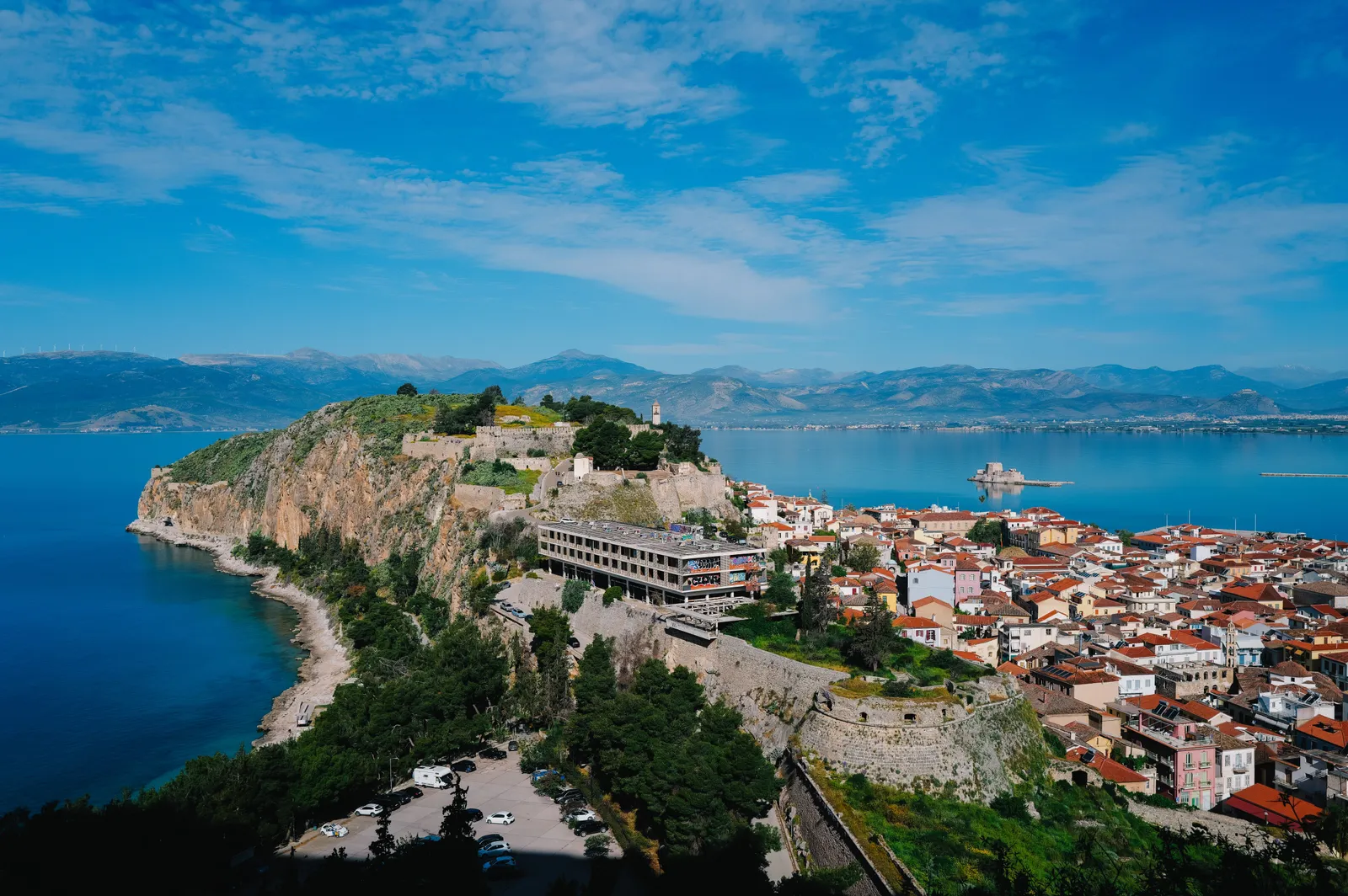
Then on to Nafplio, which is where you sleep. It was the first capital of independent Greece, and it looks it: Venetian and neoclassical buildings, marble streets, a waterfront promenade, and a small fortress sitting on an islet in the middle of the harbour.
Wow moment of the day: the climb to the Palamidi fortress above the town. The stepped route up is famously long, traditionally counted at around a thousand steps, and the view from the top takes in the whole gulf. Go up in the cool of the evening or drive round the back.
Day 2: Epidaurus and Mycenae
Two of the most important ancient sites in Greece, half an hour apart.
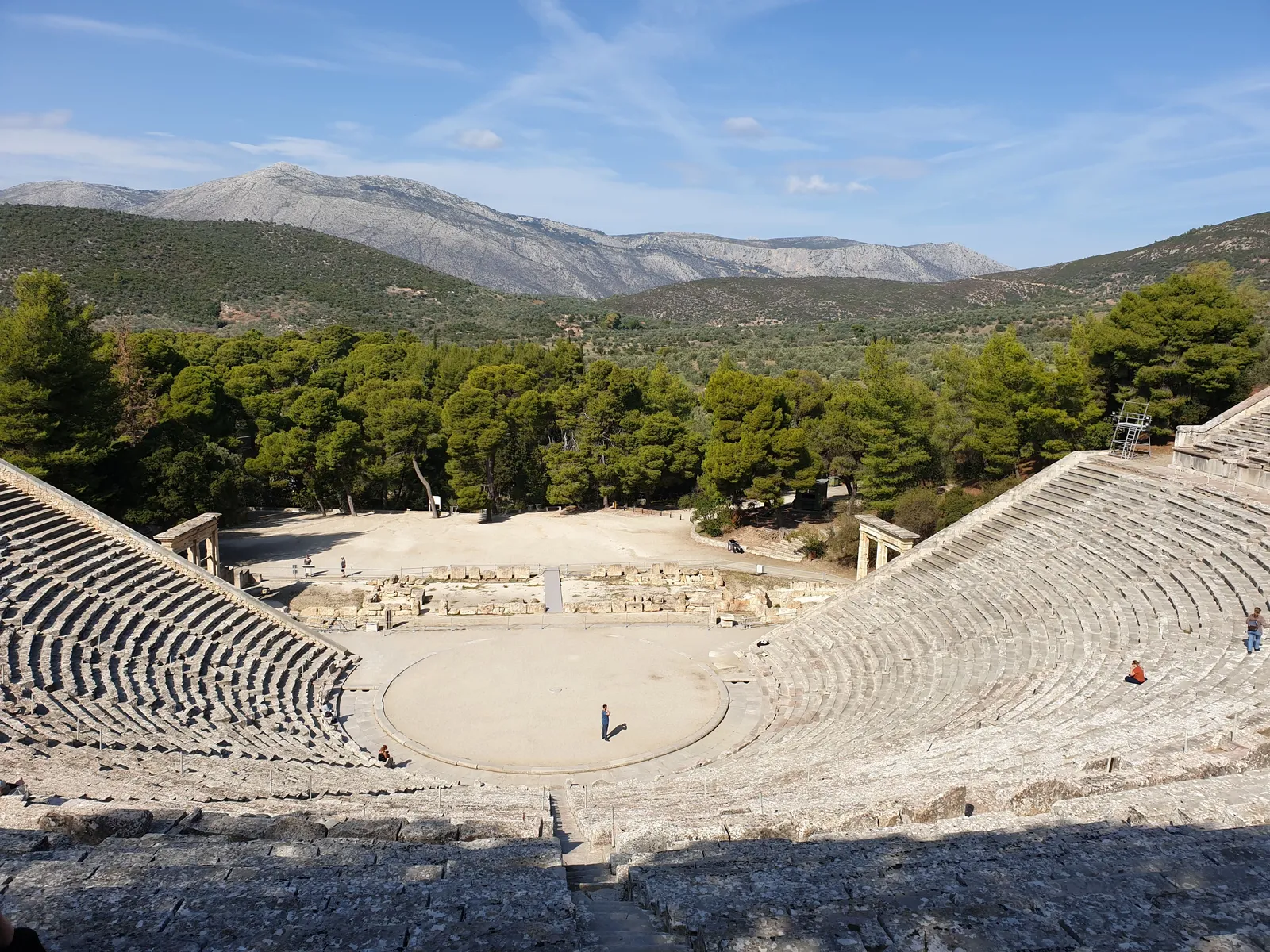
Epidaurus first, and early. The theatre, built in the fourth century BC, seats around fourteen thousand and has acoustics so exact that a coin dropped on the orchestra floor is audible from the top row. Wow moment of the day, and everyone does it: someone will be standing in the centre speaking quietly while their friends listen from the back. Take your turn.
Mycenae after. This is the citadel of Agamemnon in the epic, a Bronze Age fortress of enormous unmortared blocks that later Greeks assumed had been built by giants. You enter through the Lion Gate, walk the grave circle where the gold masks were found, and go on to the Treasury of Atreus, a beehive tomb whose stone dome was the largest unsupported span in the world for well over a thousand years.
Honest note: both sites are open and unshaded, and there is very little cover at Mycenae. This is a morning day in summer, not an afternoon one.
Day 3: Sparta and Mystras
Drive south through the mountains to the plain of Sparta. Honest note about Sparta itself: the ancient city built almost nothing monumental, on principle, so there is very little to see. The modern town is pleasant and ordinary, and the archaeological museum is the reason to stop.
The reason to come here is Mystras, five kilometres away on the slopes of Mount Taygetos. A Byzantine city of churches, palaces and mansions climbing a steep hillside to a Frankish castle at the top, abandoned in the nineteenth century and left standing.
Wow moment of the day: the frescoes. Several of the churches are still roofed and still painted, and you walk into a fourteenth century interior with the colour on the walls. Start at the top gate and walk down rather than the reverse; it is a serious slope.
Day 4: Monemvasia
Monemvasia is a rock the size of a small mountain, joined to the coast by a single causeway. The name means “single entrance”, and that is exactly the point.
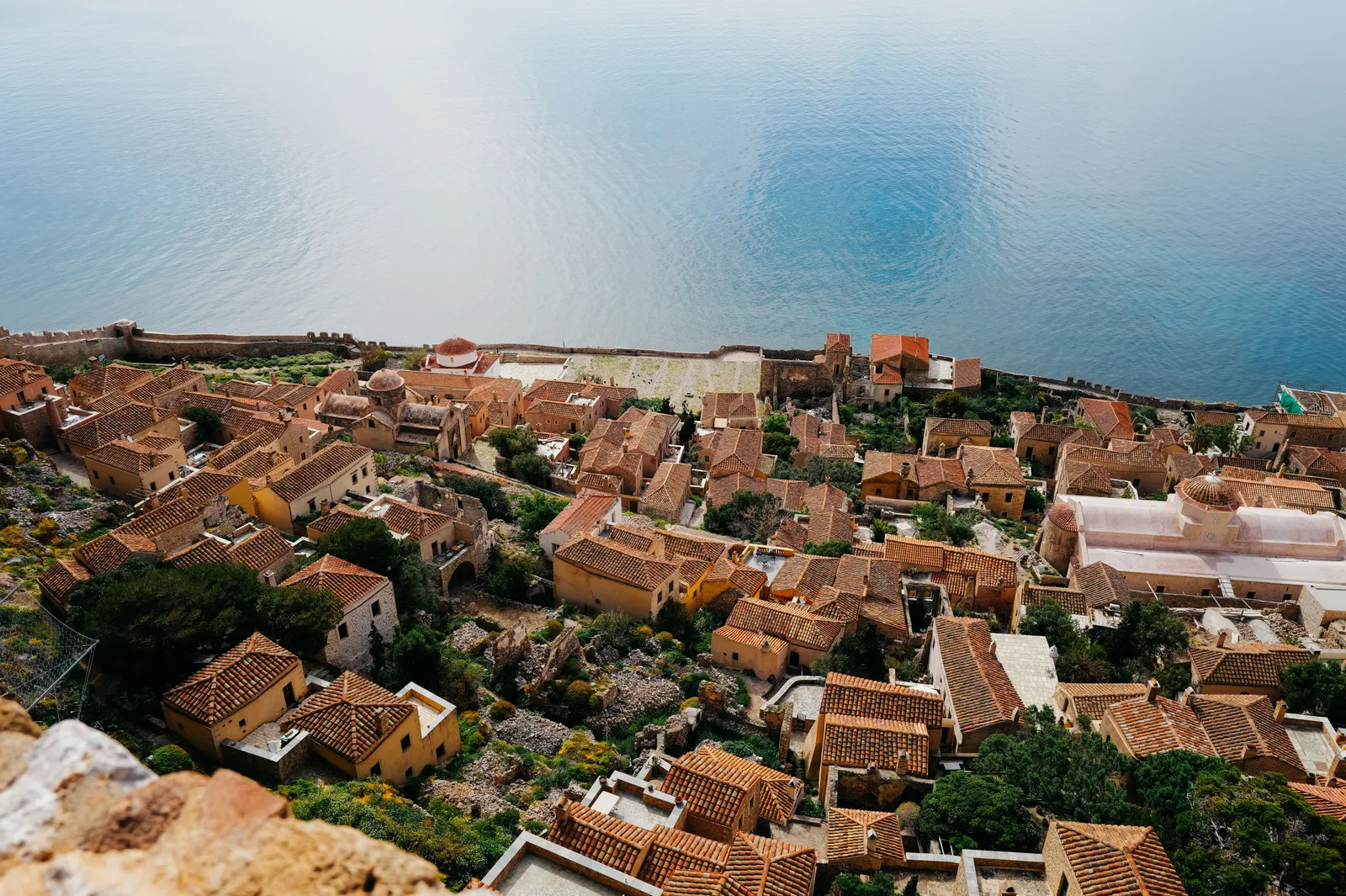
From the mainland you see a bare cliff and nothing else. The entire medieval town is on the far side, facing the open sea, completely hidden until you walk through the gate in the wall. It is still inhabited, cars cannot enter, and the lanes are stone and stepped.
Wow moment of the day: that first step through the gate, when a town appears where the map showed a rock.
Climb to the upper town on the plateau above for the church of Agia Sofia on the cliff edge and a view straight down onto the roofs below. It is a stiff climb on an old path with no shade, so take water.
Day 5: Olympia, or the Mani
Two very different ways to end, and both are good.
Olympia, in the northwest, is where the games were held for over a thousand years. The site is green and shaded, unusually for Greece, and includes the workshop where the great statue of Zeus was made. The stadium is still there, and you can walk out onto the track through the vaulted entrance tunnel and stand on the original stone starting line.
The Mani, in the south, is the middle finger of the Peloponnese: a stark stone peninsula of fortified tower houses built by feuding families, dry hills, and Byzantine chapels. Areopoli and Vathia are the classic stops, and the Diros caves on the coast are toured by boat along an underground river.
If you have a sixth day, do both.
What did not fit, and it is worth knowing
The Peloponnese is big, and this route covers the eastern and southern half. Left out are Olympia’s neighbours in the west, the ancient theatre and temple at Bassae up in the mountains, and the Voidokilia beach and Pylos on the southwest coast, which is one of the loveliest stretches of shoreline in mainland Greece and a long way from everything on this list. The mountainous middle, around Dimitsana and Stemnitsa in Arcadia, is a stone village region much like the north and deserves its own two days.
If you have a week rather than five days, add the southwest. If you have five, resist the urge to chase it, because the drive across the peninsula is genuinely slow.
Practical tips
- You need a car. Public transport between these sites is impractical. See car rental in Greece.
- Distances: the Peloponnese is mountainous and the roads wind. Assume journeys take longer than the map says, especially south of Sparta.
- When to go: spring and autumn are ideal. The archaeological sites are exposed and the interior is very hot in July and August. See the best time to visit Greece.
- Basing yourself: Nafplio for the first two nights, then move south. Trying to do all of this from Athens means driving the same roads twice.
- Day trips instead: if five days is too much, Nafplio and Mycenae work as a long day from the city. See day trips from Athens.
- Getting here: see Athens airport transfers for collecting a car on arrival.