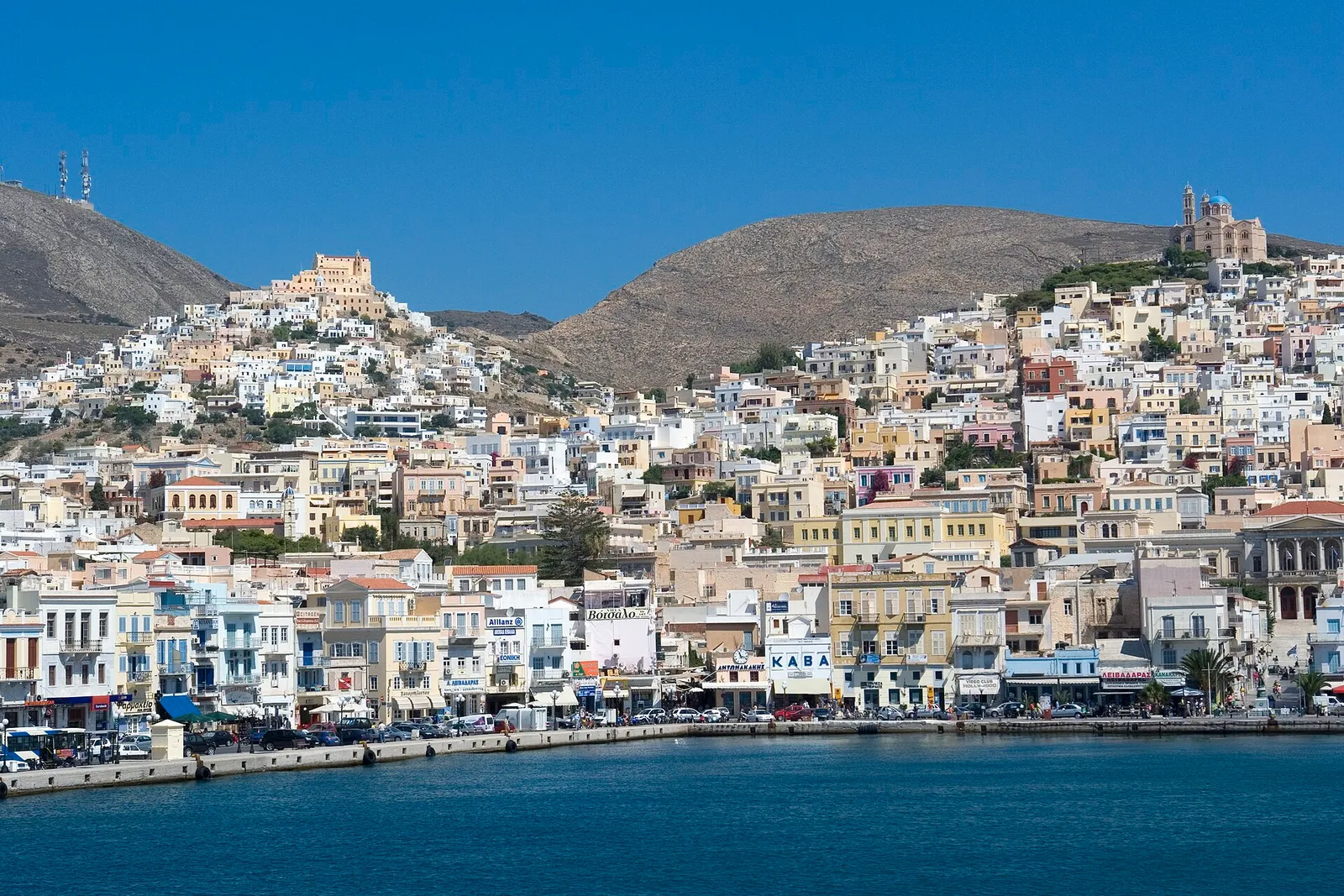
Syros is the island most Cyclades regulars mention only once you already have a ferry ticket in hand, because it does not advertise itself the way Mykonos or Santorini do. It is the administrative capital of the Cyclades, a working port with a permanent population and public institutions that have nothing to do with tourism, wrapped around one of the handsomest nineteenth century town centres in Greece. Where the famous islands empty out every October, Syros carries on as normal, and that single fact changes how to plan a visit.
We arrived expecting a short stopover and stayed for the town alone. This is the practical version: what Ermoupoli looks like, why the island has two religious traditions built into its skyline, and where Syros fits on a hop between Naxos, Paros or Mykonos.
A capital, not a resort
Syros carries the title of administrative capital of the Cyclades for a reason: the regional courts, the main hospital and the prefecture offices sit here, and the local economy runs on far more than sunbeds. In the nineteenth century, Ermoupoli, whose name honours Hermes, god of trade, grew into the main port of the newly independent Greek state, a shipping hub whose wealth paid for the marble squares and mansion houses still standing today. That history is the real difference between Syros and its glamorous neighbours: Mykonos and Santorini built their skylines for visitors, while Syros built its for itself and let visitors in afterwards.
That shapes the kind of trip worth planning here. Syros suits people who like architecture, unhurried cafe culture and a working town over anyone chasing a big beach club scene. If you are still choosing between islands rather than adding one to a route you already have, our guide to choosing a Greek island is the place to start before you book a ferry ticket.
Ermoupoli’s neoclassical streets
Ermoupoli climbs two hills above a wide harbour, and the lower town is one of the best looking in Greece. Pastel neoclassical mansions line steep streets, marble paving runs across the main square, Miaouli, and a grand town hall faces onto it. Just off the square stands the Apollon Theatre, a nineteenth century opera house often described as a scaled down version of Milan’s La Scala, still hosting performances today.
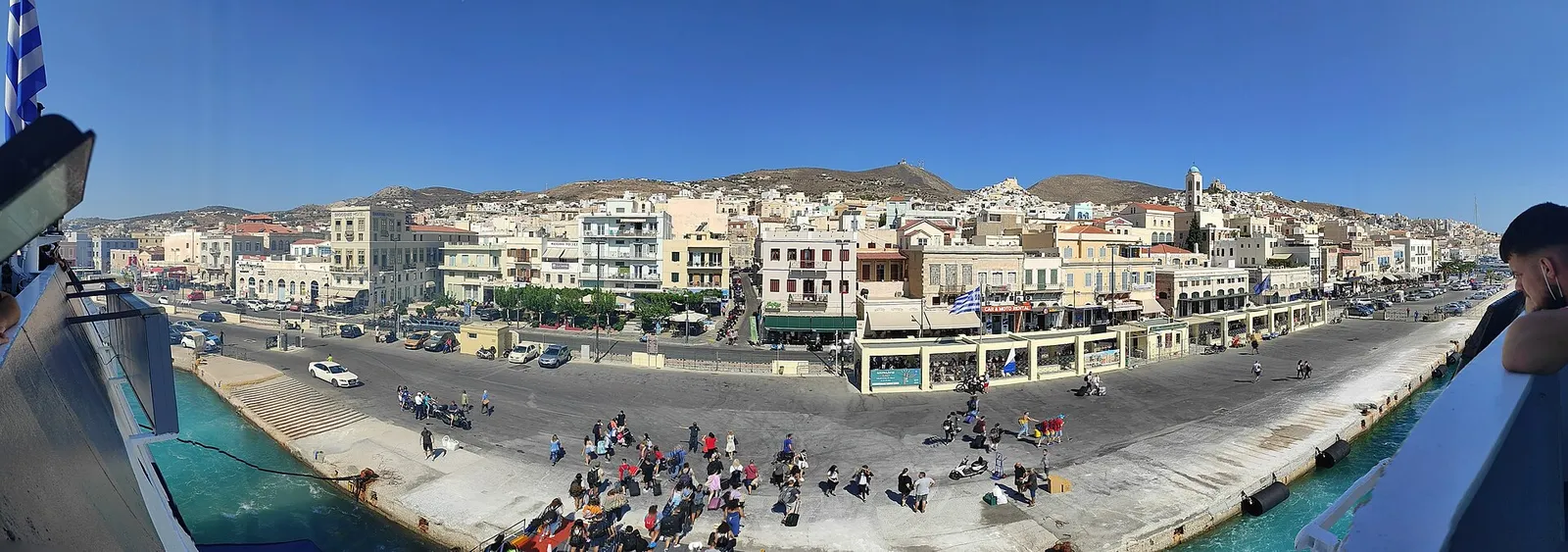
Away from the square, the harbourfront is where the everyday town happens: pharmacies, banks and family tavernas sit alongside cafes aimed at visitors, part of what makes walking here feel different from a tourist-facing island town. Sit with a coffee for half an hour and you notice how much of the foot traffic is local.
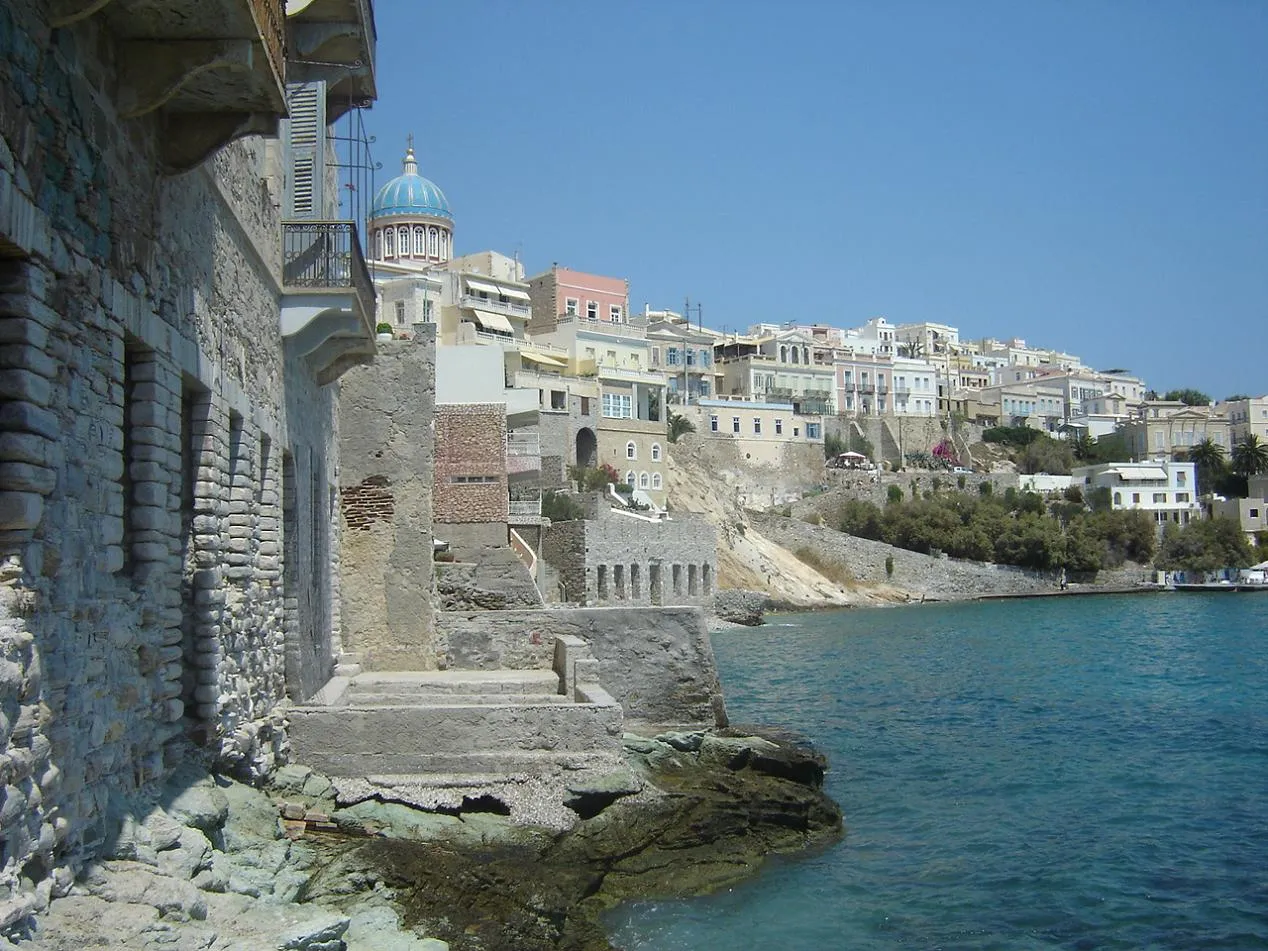
Two hills, two faiths
The two hills that frame Ermoupoli are more than a nice view, they tell the island’s religious history. Ano Syros, the older settlement, climbs the western hill in a maze of whitewashed lanes and stepped alleys, a legacy of Venetian rule, crowned by the Catholic Cathedral of St George. Syros has one of the largest Catholic communities in Greece as a result of that period, living alongside an Orthodox majority whose own cathedral and churches occupy the opposite hill. Walking up to Ano Syros in the late afternoon, past doorways with worn stone lintels, is the best hour on the island, and the view over both hills and the harbour repays the climb.
Do not expect a plaque explaining this at every corner. What Syros offers instead is a lived example: two congregations, two hilltop landmarks, and a town that appears never to have made much of a fuss about the difference.
Beaches and villages beyond the town
Beaches are not why people come to Syros, and it is worth saying that plainly so nobody arrives with the wrong expectations. What is here is pleasant rather than dramatic: small bays, clear water and considerably less development than the well known islands nearby.
Galissas, on the west coast, is a former fishing village with a sandy beach and a relaxed, bohemian feel. Kini, close by, is the sunset spot, a row of tavernas facing the sea. Vari, Achladi and Komito, on the south coast, are calmer, sandier and popular with families. The rugged north, Ano Meria, has scattered traditional villages and a wilder coastline for an afternoon off the main road.
None of this is a reason to skip the more dramatic coastlines elsewhere in the Cyclades. If beaches are the priority, treat Syros as the cultural stop on a route rather than the beach stop.
Getting to Syros and around it
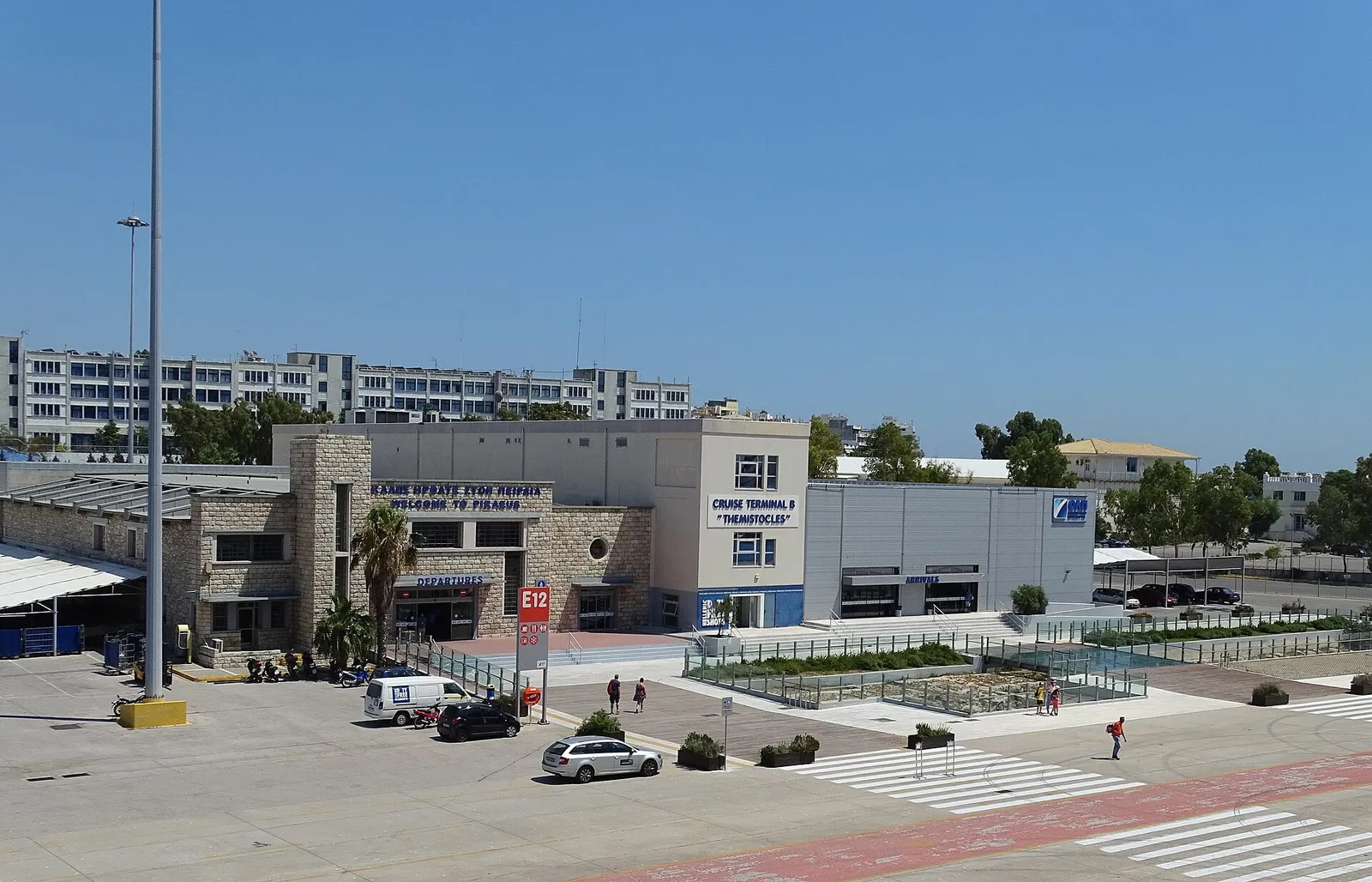
Syros sits on the main Cycladic ferry network, so getting here rarely means a special trip on its own. From Athens, the standard route is a ferry from Piraeus, with the crossing lasting roughly two and a half to four hours depending on whether you book a conventional ferry or a faster catamaran. Timetables shift with the season and the wind, so treat any journey time as a rough guide and check the current schedule with the operator close to your dates. Our guide to the port of Piraeus covers gates, tickets and what to do if a sailing is cancelled. A small airport also has a limited number of domestic flights from Athens.
As the administrative hub of the Cyclades, Syros also has frequent onward connections to Mykonos, Tinos, Paros and Naxos, exactly what makes it a natural stop rather than a detour. Ermoupoli itself is walkable, but a hire car or scooter is worth having for a day to reach the northern villages or the southern beaches. Expect a small car to cost roughly 35 to 45 euros a day in high season, though rental prices move with demand and fuel costs, so check with the hire desk before you budget around it. Book ahead in July and August, when demand across the Cyclades outstrips supply.
Where Syros fits in your Cyclades trip
Syros works best as a deliberate stop rather than an accident, because it rewards a night or two of its own rather than a few hours between ferries. Two to three days covers Ermoupoli, the walk up to Ano Syros, and a day for the beaches or villages further out.
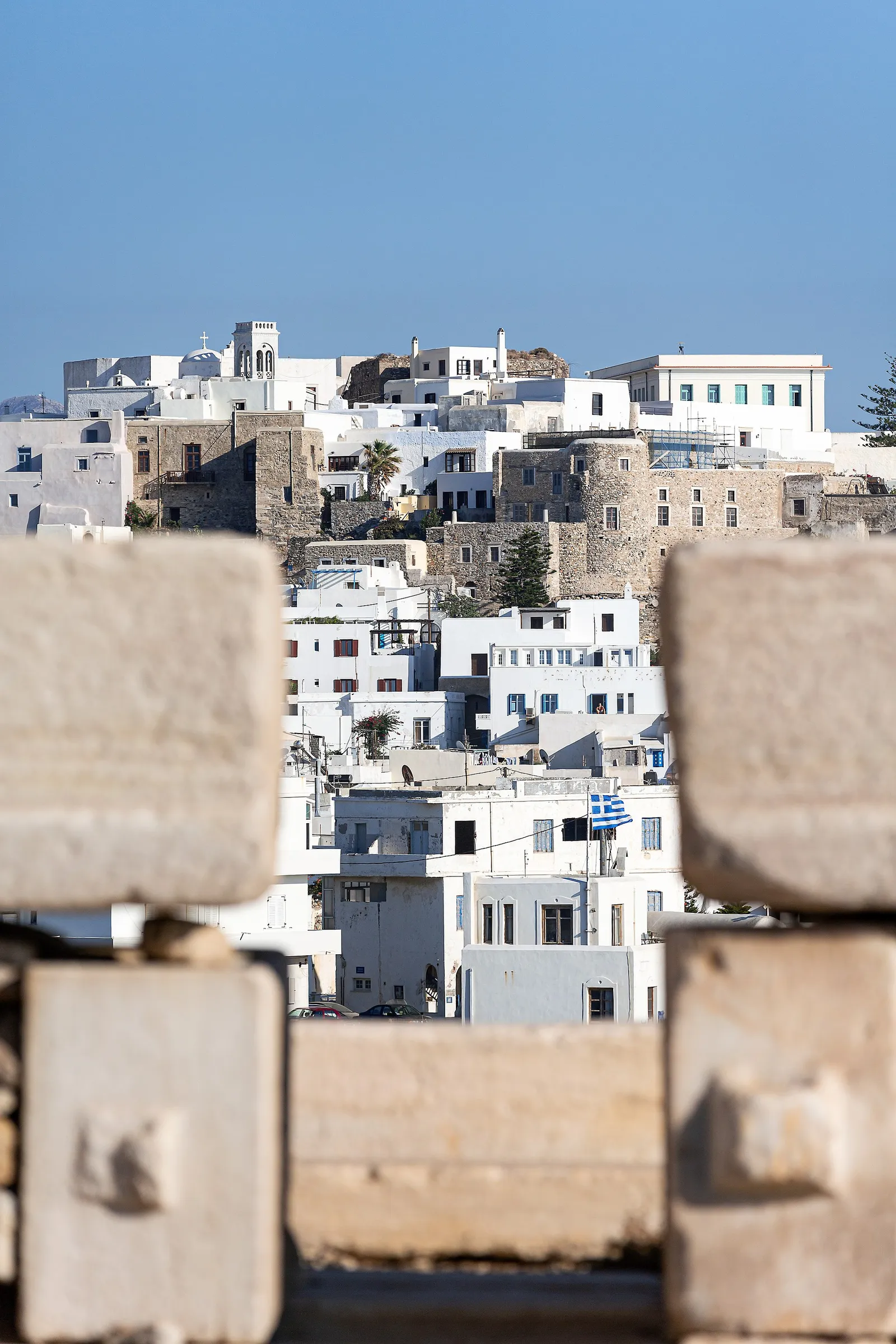
It also pairs naturally with islands most travellers already have on a list. The connection onward to Paros and Naxos is short and frequent, and our guide to Naxos covers the greener, beach-heavy island that makes a good contrast after a couple of days in a proper working town. Coming from Athens or Mykonos, Syros works well as the first or last stop on a longer Cyclades route, the one that shows a different side of the islands.
Give it the time it asks for, and Syros stops feeling like the island nobody mentions and starts feeling like the one you recommend first.